
Technical guide

Technical guide

How each layer works, from the MCP Tool Shed to the Modernisation Springboard, with runnable labs, engine grades, costs and sources.

  1. 0Existing Stack
  2. 1MCP Tool Shed
  3. 2System 1 (Jev)
  4. 3ADK with Gemini and Spanner Graph
  5. 4Modernisation Springboard
Planned Google Cloud reference architecture

Product roles with a clear live boundary.

The live service is one Rust process serving these static pages and the same-origin API from Cloud Run. The Google Cloud reference architecture below is planned and not live in this demo.

Live today

  • Cloud Run hosts the publication and same-origin API.
  • Deterministic Rust and browser rules power the existing demonstrations.
  • The current demo does not run MCP servers or call managed model services.

Planned reference

  • Managed Google Cloud roles support migration and modernisation delivery.
  • Model layers interpret intent, route work and gate bounded decisions.
  • Deterministic code and SQL parse exact formats, count rows and validate schemas.

Agent orchestration

One planned Gemini Migration Agent, built with Agent Development Kit (ADK), carries each workload through Google's four migration phases. Jev gates bounded decisions in every phase, a person approves the plan before Deploy, and deterministic services do the moving and the counting. None of this is live in this demo.

  1. AssessThe agent summarises inventory and dependency evidence from governed MCP tools, which may run on Compute Engine, and from Migration Center discovery. Spanner Graph holds the dependency map. Jev routes each finding.
  2. PlanThe agent proposes the destination, sequence, cutover, rollback and acceptance tests. Jev stops low-confidence choices becoming actions. A person approves the plan.
  3. DeployDeterministic migration services move data and workloads to Cloud Storage, BigQuery, AlloyDB AI, Compute Engine or Cloud Run, as the plan chose. Code and SQL validate before cutover. The agent coordinates; it does not move bytes.
  4. OptimiseBigQuery holds eval records and telemetry, and Looker reports quality, cost and performance. The agent proposes the next improvement.

AlloyDB AI holds operational PostgreSQL state and calls TypeSafe's hosted Jev API through AI functions and Model Endpoint Management. Jev is not embedded in AlloyDB. Google Cloud RAG Engine provides managed parsing and retrieval where suitable.

Reading a migration lane

Source
The system the work starts from, such as Microsoft 365, Amazon S3, an Oracle database or a virtual machine.
What moves
The artefact itself: files, tables, change streams, jobs or a whole workload.
Movement or service
The deterministic service or code that moves it. MCP exposes tools; it does not copy objects.
Destination
Where it lands, chosen by workload. Not all data belongs in BigQuery.
Validation or evidence
The checks that prove it arrived intact, such as counts, checksums and schema validation. Gemini interprets the report.

DiffusionGemma can run behind the same discriminative-model API on Compute Engine or Cloud Run in the planned reference architecture. It is not deployed in this demo.

Layer 1 · MCP Tool Shed · Connectivity

Governed MCP servers replace one-off scripts.

In the planned reference architecture, governed MCP servers expose scoped tools and resources with short-lived credentials and an audit trail. Compute Engine is one possible host where persistent processes or network placement require it. MCP is not a parser. The current demo does not run MCP servers.

The MCP server catalogue

Official servers only, each verified on a working vendor page on 12 October 2026. Most are new or in preview; check the link before relying on a detail.

Official MCP servers by system, with transport, authentication, scope, source and date checked
SystemOfficial MCP serverRemote or localAuth modelTypical read and write scopeSourceChecked
AWS (S3)Vendor AWS MCP Server, which calls S3 and other AWS APIs through a small fixed set of toolsRemote (managed)OAuth 2.1, or IAM SigV4 through the local MCP Proxy for AWSAny AWS API the IAM principal may call; IAM condition keys can restrict agent actions, and SigV4 offers a read-only modeAWS documentation12 October 2026
Azure (Blob Storage)Vendor Azure MCP Server, Storage toolsLocal (self-hosted deployment also documented)Microsoft Entra ID through the Azure Identity library; Azure RBACCreate, get, list and upload storage resources, within the caller's RBAC roleMicrosoft Learn12 October 2026
Google Cloud (BigQuery)Vendor BigQuery remote MCP server; a local server through MCP Toolbox for Databases also existsRemoteGoogle Cloud IAM, with centralised audit loggingRun queries, get metadata, list resourcesGoogle Cloud documentation12 October 2026
SAPTwo routes, neither a ready-made SAP server SAP does not ship a ready-made MCP server for SAP business data. You can use SAP's MCP Gateway in SAP Integration Suite, which exposes the SAP APIs you choose as MCP tools. Or you can use the AWS for SAP MCP Server, built by AWS and generally available since 1 May 2026. It runs on Amazon Bedrock AgentCore and uses SAP's OData APIs for S/4HANA and ECC.Remote: the SAP gateway, or AgentCore Runtime on AWSGateway: OAuth 2.0 with OIDC, with the user's identity propagated into SAP. AWS: AgentCore Identity with OAuth 2.0Gateway: only the APIs and operations you publish, under the signed-in user's SAP authorisations. AWS: create, read, update and delete SAP business objects such as sales orders, purchase orders, materials and finance documentsSAP Architecture Center; AWS announcement12 October 2026
SalesforceVendor Salesforce Hosted MCP ServersRemotePer-user OAuth 2.0 with PKCERead, create, update and delete records, respecting field-level security and sharing rules; admins choose which servers are enabledSalesforce Developers12 October 2026
DatabricksVendor Databricks managed MCP servers (public preview)RemoteOAuth, including on behalf of the user; Databricks data permissions always applyGenie servers are read-only; the Databricks SQL server reads and writes; AI Search queries indexesDatabricks documentation12 October 2026
ServiceNowVendor MCP Server Console, with a pre-configured Quickstart ServerRemote (Streamable HTTP; stdio not supported)OAuth 2.0 authorisation code grant; third-party identity providers supportedOnly the tools an administrator packages; existing access controls and roles applyServiceNow FAQ12 October 2026
Atlassian (Jira, Confluence)Vendor Atlassian Rovo MCP ServerRemoteOAuth 2.1; API token optionalSearch and summarise Jira and Confluence; create and update work items and pages, within the user's permissionsAtlassian Support12 October 2026
Microsoft 365 (SharePoint, OneDrive, Word, Excel, PowerPoint files)Vendor Work IQ MCP servers (preview), including SharePoint, OneDrive and Word serversRemoteMicrosoft Entra ID; admins allow or block servers centrally; needs a Microsoft 365 Copilot licenceSharePoint: files of 5 MB or less, lists and sharing; OneDrive: the user's own files; Word: create and read documentsWork IQ overview, SharePoint reference12 October 2026
LookerVendor Looker-managed MCP server (preview); MCP Toolbox for Databases for customer-hosted instancesRemote (instance URL plus /mcp)OAuth 2.1; the agent inherits the signed-in user's Looker rolesEvery tool is disabled until an admin enables it; then queries, Looks and dashboards the user can already seeGoogle Cloud documentation12 October 2026

Marks belong to their owners. Excel and PowerPoint files come through SharePoint and OneDrive; we found no dedicated server for either.

Lab 4: tool scoping

Loading every tool definition into every request spends context before work starts [L5]. A System 1 router loads only the servers the task needs. Every input is an assumption; set them for your estate.

View and edit the code
Layer 2 · System 1 (Jev) · Reflexes

Fast models gate every step.

A System 1 model is small and fast. It returns a typed decision with calibrated confidence, not free text. TypeSafe calls these System One models [L8]. Jev takes a state and typed questions, and returns typed answers, probabilities and a confidence that code can branch on [L9].

TypeSafe reports 70 to 500 ms end to end [L8] Vendor-reported, against seconds for a frontier model. Fast enough to gate every tool call. It does not stop hallucination; it stops uncalibrated output becoming action.

An independent review measured a 524 ms median for a hosted round trip [L10].

Lab 3: per-action confidence thresholds

A simulated confidence gate; no model is called. A case is automated if its confidence clears the action's threshold, else reviewed at a cost of 1. Error costs (50, 2 and 5), review cost and 3,000 cases are illustrative; thresholds are editable assumptions. Raise overconfidence to watch calibration break.

View and edit the code
Layer 3 · ADK with Gemini · Logic and context

System 2 orchestration with bounded inputs.

In the planned reference architecture, ADK with Gemini orchestrates agents and tool use after System 1 filters routine decisions. Google Cloud RAG Engine retrieves relevant document context, while Spanner Graph supplies lineage and semantic relationships. Deterministic hooks validate schemas, block unsafe actions and require approval. These services are not connected to the current demonstrations.

A skill Illustrative
A short SKILL.md for one migration pattern. Fixed steps mean two runs follow the same path.
---
name: migrate-sap-table-to-bigquery
description: Migrate one SAP table to BigQuery without breaking downstream reports.
---
# Migrate an SAP table to BigQuery

1. Read lineage. Ask the lineage graph for every column, job
   and report downstream of the table. If the table is not in
   the graph, stop and ask.
2. Generate DDL. Write the BigQuery CREATE TABLE statement
   from the SAP data dictionary, using the agreed type map.
3. Generate view aliases. For every renamed column, create a
   view that keeps the old name so downstream reports still work.
4. Validate against the target schema. Fail on a missing
   column, a type mismatch or a changed key.
5. Write the eval record: decision, confidence, tools called,
   tokens, latency and outcome.
A pre-tool-call hook Illustrative
Runs before every tool call and can block it. Agents cannot argue past it.
def before_tool_call(call, context):
    # Block writes to production unless a person has approved them
    if call.is_write and call.target_env == "production":
        if not context.has_valid_approval_token(call):
            return block("Writes to production need an approval token.")

    # Check generated DDL against the target schema before it runs
    if call.tool == "bigquery.execute_ddl":
        problems = validate_ddl(call.args["ddl"],
                                target_schema(call.args["table"]))
        if problems:
            return block("DDL does not match the target schema: "
                         + "; ".join(problems))

    return allow()
Layer 3 · Context fabric: Spanner Graph · Relational context

A graph of lineage and meaning.

A graph engine such as Spanner Graph records lineage across tables, jobs, files and reports, and what each business term means. Agents check upstream and downstream before any change.

Spotlight

Google Cloud Spanner Graph

One database. Relational and graph views.

Spanner Graph maps tables or SQL views into a property graph without copying data. GQL for graph patterns, SQL for relational work, or both.

  • Multi-model, per Google Cloud: a property graph schema declared over existing tables or views. Needs Enterprise or Enterprise Plus edition.
  • Graph queries use an ISO GQL-compatible interface.
  • GoogleSQL reads graph matches through GRAPH_TABLE, so graph and relational results meet in one query.
  • It inherits Spanner’s scale, availability and strong consistency.

Capabilities are from Google Cloud documentation. Grades and scores below are this site’s independent judgement. This spotlight does not change them; Spanner Graph keeps its evidence-based B grade. Jev, TypeSafe's System 1 decision model, is not a Google Cloud product.
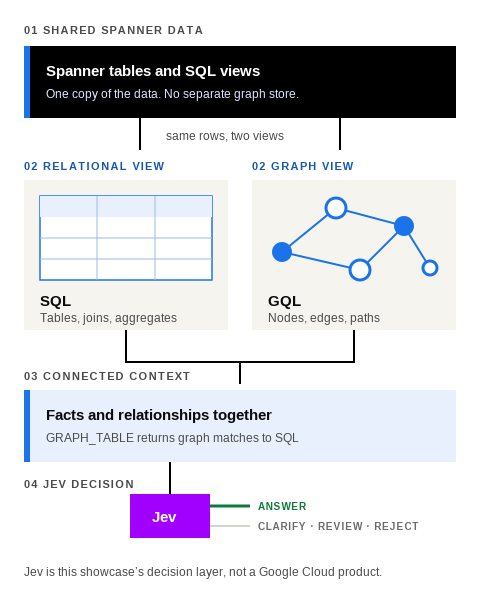
Diagram: Spanner tables and SQL views hold one copy of the data, exposed both as a relational view queried with SQL and as a property graph queried with GQL. Together they give connected context to Jev, which answers, clarifies, sends for review or rejects.

Strong fit

  • Operational data already lives in Spanner.
  • You need relational and relationship queries over the same data.
  • Strong consistency and managed multi-region matter.
  • You prefer a managed Google Cloud database.
  • Graph context should sit next to transactional facts, not in a synced copy.

Consider carefully

  • It is a Google Cloud service, not portable or embedded.
  • Cost and capacity follow Spanner’s model.
  • Test schema mapping, query shape, latency and traversal depth on representative data.
  • Test the GQL features and graph algorithms you need; do not assume parity with graph-native products.
  • A dedicated graph store may suit some graph-first workloads better.
Engine grades and scoresGraded against the job each engine is built for.

Embedded and clustered engines do different jobs. Weights are the author's judgement: traversal depth 30%, operations 25%, total cost 20%, vendor viability 15%, fit for decision-model state 10%.

Native graph store Graph over existing data Document store with graph features Embedded

Scores by criterion

Scores out of 5: judgement, not measurement. PuppyGraph's depth score rests on unverified vendor figures.

Entry production costApproximate monthly list prices in USD, as at 25 September 2026; Spanner Graph checked 2 October 2026.

Paler bars show a range. Native stores' duplication and sync costs, often larger, are excluded. Vendor pricing: Sources and caveats.

Labs on the sample estate

Both run in your browser on the landing page's 15-fact sample estate: SAP, BigQuery, Databricks, Looker, Salesforce and SharePoint objects linked by lineage. Edit the settings or the code.

Lab 1: hybrid text against graph retrieval

The usual text baseline: BM25 over node text plus all-MiniLM-L6-v2 dense similarity, fused by reciprocal rank fusion. scripts/dense.py precomputes dense scores for the four presets; typed questions use BM25 only. Graph retrieval follows relationships from the named entities.

View and edit the code

Lab 2: best context for a token budget

Personalised PageRank ranks nodes by centrality to the start entity; the top text fills the budget. TypeSafe documents 64k tokens per request for Jev 1.13, 32k for state plus the longest question [TypeSafe models]. This tiny graph gets a scaled-down budget, at 1.3 tokens per word.

View and edit the code

One question, five dialects

Which dashboards use KNA1.REGION? One two-hop lineage query: SAP column, BigQuery mapping, Looker dashboards.

MongoDB behaviour: $graphLookup documentation.

Run it on your laptopLocal options, where they exist.

Neptune, Spanner Graph and Fabric graph are cloud-only.

Layer 4 · Modernisation Springboard · Visibility and cost

What agents did, and what it cost.

In the planned reference architecture, every agent step writes an eval record: decision, confidence, tools called, tokens, latency and outcome. BigQuery stores normalised and analytical data, eval records and telemetry. Looker reports outcomes, quality and cost, including cost per migrated object. The current demonstrations do not write these records to Google Cloud.

One eval record Illustrative
One JSON object per step; values are made up. cost_usd is null: compute it from tokens and your contracted rates.
{
  "run_id": "run-2026-10-12-0042",
  "step": "validate_schema",
  "agent": "migration-agent",
  "skill": "migrate-sap-table-to-bigquery",
  "tools_called": ["lineage.read", "bigquery.get_table_schema"],
  "decision": "proceed",
  "confidence": 0.94,
  "outcome": "answer",
  "tokens_in": 1820,
  "tokens_out": 140,
  "latency_ms": 310,
  "cost_usd": null,
  "object_id": "sap:KNA1",
  "timestamp": "2026-10-12T04:15:00Z"
}
The BigQuery table Illustrative
Partitioned by day, so reports scan only needed dates. Clustered by skill and outcome for the tiles [L11].
CREATE TABLE IF NOT EXISTS migration_evals.eval_records (
  run_id       STRING    NOT NULL,
  step         STRING    NOT NULL,
  agent        STRING,
  skill        STRING,
  tools_called ARRAY<STRING>,
  decision     STRING,
  confidence   FLOAT64,
  outcome      STRING,
  tokens_in    INT64,
  tokens_out   INT64,
  latency_ms   INT64,
  cost_usd     NUMERIC,
  object_id    STRING,
  timestamp    TIMESTAMP NOT NULL
)
PARTITION BY DATE(timestamp)
CLUSTER BY skill, outcome
OPTIONS (description = "One row per agent step");

Three Looker tiles

Built in Looker over this table [L12]. No figures shown; none have been measured.

  1. Cost per migrated object. cost_usd summed over distinct object_id values whose final step ended in answer, by week. Is it falling as skills and thresholds improve?
  2. Outcomes by step. Step counts by step, stacked by outcome (answer, clarify, reject, review, no_data; shown as Proceed, Ask, Refuse, Escalate and No data). Where agents stop, and why.
  3. Escalation rate by skill. Share of steps with outcome review per skill, with median confidence. A rise flags a playbook or threshold to fix.

Sources and caveats

Prices are vendor list prices checked on 25 September 2026. Confirm with each vendor's calculator before quoting. Memgraph was checked on 30 September 2026. Spanner Graph was checked on 2 October 2026: Enterprise edition in us-central1 is $0.41 per replica hour, three replicas per regional node, so $1.23 per node hour. Over 730 hours that is about $90 for 100 processing units and $898 for one node, before storage, backups and network. PuppyGraph, FalkorDB and Jev performance claims are vendor-reported. Kuzu was archived in October 2025; the forks named here are community-maintained. Grades are the author's judgement against the stated weights. The MCP server catalogue and TypeSafe context length were checked on 12 October 2026.

Vendor pages: Neo4j, FalkorDB, Memgraph (Community licence: BSL 1.1; internal production use, no database-as-a-service; each version becomes Apache 2.0 on its licence's change date, at most four years after release), Neptune, Spanner pricing (capabilities: Spanner Graph overview, graph queries, what is a graph database), PuppyGraph, Fabric graph, MongoDB, Kuzu status.